
North America Customs Brokerage Market Size
The North America customs brokerage market was valued at USD 9.45 billion in 2024, is estimated to reach USD 10 billion in 2025, and is projected to reach USD 15.75 billion by 2033, growing at a CAGR of 5.84% from 2025 to 2033.
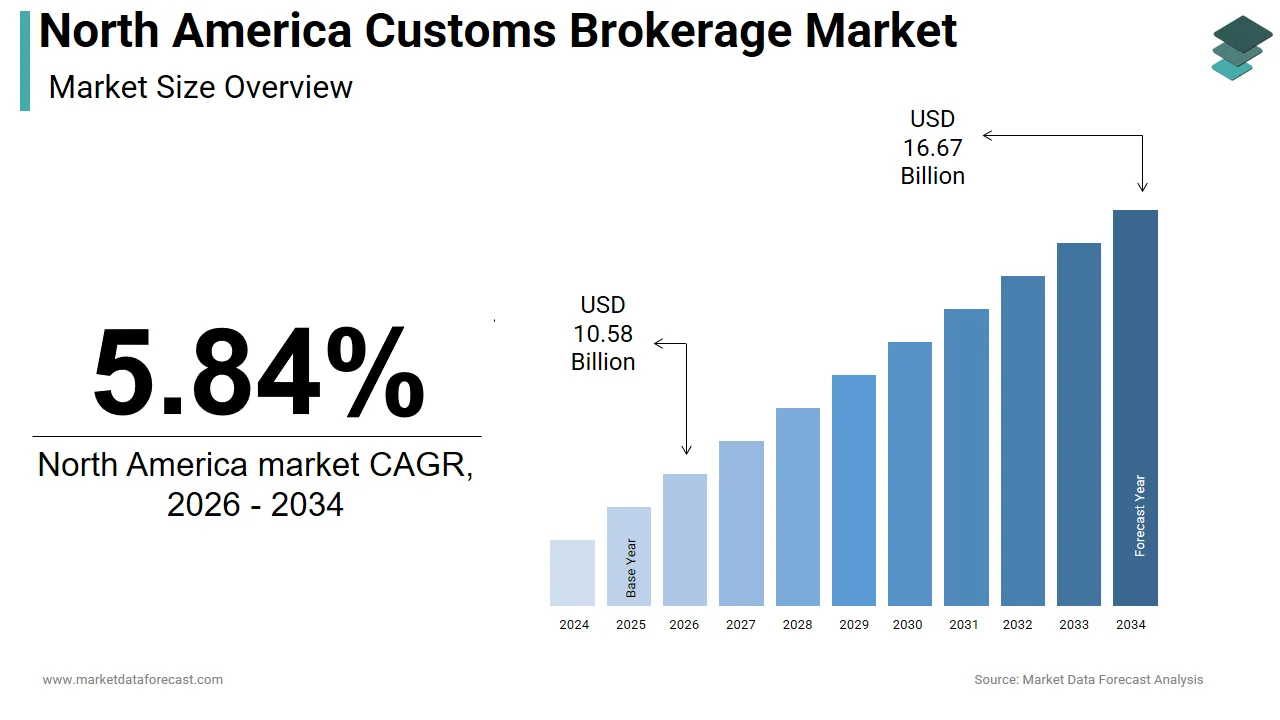
Customs brokerage covers specialized professional services provided by licensed customs brokers who facilitate the importation and exportation of goods across international borders by ensuring compliance with complex regulatory requirements, tariff classifications, and documentation procedures. These licensed professionals serve as intermediaries between importers, exporters, and government agencies, navigating the intricate web of customs regulations, trade agreements, and security protocols that govern international commerce. The market operates within a highly regulated environment where customs brokers must maintain federal licensing, demonstrate extensive knowledge of tariff schedules, and possess comprehensive understanding of trade compliance requirements across multiple jurisdictions. The market’s operational framework involves sophisticated documentation management, tariff classification expertise, and regulatory compliance monitoring that ensures seamless movement of goods while minimizing delays and penalties. The complexity of modern trade agreements, including the United States-Mexico-Canada Agreement and various bilateral trade arrangements, has increased the demand for specialized customs expertise that can navigate evolving regulatory landscapes. As per the International Chamber of Commerce, over 68% of North American importers now utilize licensed customs brokers to ensure regulatory compliance and optimize duty payments, reflecting the critical importance of professional brokerage services in facilitating international trade throughout the region.
MARKET DRIVERS
International Trade Volume Expansion
The substantial increase in international trade volumes across North America has emerged as the primary catalyst driving demand for customs brokerage services, as growing commercial activity necessitates specialized expertise to navigate complex regulatory requirements and ensure efficient cross-border movement of goods. The expansion of global supply chains, increased consumer demand for international products, and business growth in export-oriented industries have created unprecedented volumes of import and export transactions that require professional customs facilitation. The United States-Mexico-Canada Agreement has streamlined trade processes while simultaneously increasing regulatory complexity, requiring specialized knowledge to optimize duty calculations and ensure compliance with rules of origin requirements. Additionally, the trend toward just-in-time inventory management and lean supply chain strategies has increased the time sensitivity of customs clearance processes, making professional brokerage services essential for maintaining supply chain efficiency and avoiding costly delays. Furthermore, the increasing complexity of product safety regulations, labeling requirements, and country-of-origin documentation has made customs brokerage expertise indispensable for importers seeking to avoid penalties and ensure regulatory compliance in the evolving international trade landscape.
Regulatory Complexity and Compliance Requirements
The escalating complexity of international trade regulations and compliance requirements has created substantial demand for professional customs brokerage services throughout North America, as businesses require specialized expertise to navigate evolving regulatory landscapes and ensure adherence to increasingly stringent import/export protocols. Modern customs regulations encompass extensive documentation requirements, product safety standards, environmental compliance measures, and security protocols that demand comprehensive knowledge and continuous regulatory monitoring to ensure successful cross-border transactions. The implementation of enhanced security measures following various international trade security initiatives has increased documentation requirements and inspection procedures that require specialized knowledge to navigate efficiently. Additionally, the proliferation of trade agreements, preferential tariff programs, and country-specific import requirements has created a complex web of regulatory pathways that require expert navigation to optimize duty payments and ensure compliance. Furthermore, the increasing frequency of regulatory updates and policy changes requires continuous monitoring and adaptation that professional customs brokers provide through their specialized knowledge and regulatory intelligence capabilities, making their services essential for businesses operating in the complex international trade environment.
MARKET RESTRAINTS
Talent Shortage and Licensing Requirements
The North America customs brokerage market faces significant operational constraints due to a critical shortage of qualified professionals and stringent licensing requirements that create supply limitations in the specialized workforce pool. The complex nature of customs regulations, extensive knowledge requirements, and rigorous licensing examinations create barriers to entry that limit the availability of qualified customs brokers to meet growing market demand. The licensing process involves comprehensive examinations covering tariff classifications, regulatory requirements, and procedural protocols that require extensive preparation and specialized training, creating extended qualification timelines and limiting new entrant flow into the profession. Additionally, the requirement for continuous education and regulatory updates necessitates ongoing professional development that increases operational costs for customs brokerage firms and creates retention challenges for qualified personnel. Furthermore, the aging workforce within the customs brokerage profession creates concerns about future capacity and knowledge transfer requirements. The specialized nature of customs brokerage work, combined with the high-stakes regulatory environment and liability exposure, creates compensation demands that strain smaller brokerage operations and limit their ability to attract and retain qualified professionals. These human resource limitations directly impact service delivery capabilities and constrain market growth potential.
Technology Investment and Automation Costs
The substantial financial investment required for technology infrastructure and automation systems represents a significant barrier to market entry and operational efficiency for North America customs brokerage firms, creating financial constraints that limit competitive capabilities and service expansion opportunities. Modern customs brokerage operations require sophisticated software platforms, automated documentation systems, and integrated compliance management tools that demand substantial capital investment and ongoing maintenance costs that strain operational budgets. The complexity of customs regulations and documentation requirements necessitates specialized software solutions that can handle multiple trade agreements, tariff calculations, and regulatory compliance monitoring, creating substantial investment requirements for comprehensive technology platforms. Additionally, the need for real-time data integration, electronic filing capabilities, and automated compliance checking systems requires continuous technology upgrades and system enhancements that create ongoing financial obligations. Furthermore, the rapid pace of regulatory changes and trade agreement updates requires frequent software modifications and system adaptations that increase technology maintenance costs and create operational complexity. Smaller customs brokerage firms often lack the financial resources to invest in comprehensive technology solutions, creating competitive disadvantages and limiting their ability to serve larger enterprise clients who require sophisticated digital capabilities. These technology investment requirements create barriers to market entry for new participants while increasing operational costs for established firms, constraining overall market growth and profitability.
MARKET OPPORTUNITIES
E-commerce Cross-Border Trade Expansion
The explosive growth of e-commerce cross-border trade throughout North America presents substantial expansion opportunities for customs brokerage market participants, particularly those offering specialized services for small package shipments and direct-to-consumer import transactions. The proliferation of online marketplaces, international selling platforms, and global supply chain integration has created unprecedented volumes of small-value import transactions that require specialized customs facilitation and regulatory compliance services. The trend toward international selling by domestic retailers and the growth of global online marketplaces has increased the complexity of import transactions, with individual shipments often requiring multiple regulatory classifications and compliance procedures. Additionally, the implementation of de minimis thresholds and low-value shipment regulations has created new service categories and revenue opportunities for customs brokers who can efficiently process high-volume, low-value import transactions. Furthermore, the integration of customs brokerage services with logistics platforms and e-commerce fulfillment systems has created opportunities for automated service delivery and scalable operations that can efficiently handle high-volume transaction processing. These e-commerce trends create sustainable growth opportunities and revenue diversification for customs brokerage firms with appropriate technology infrastructure and operational capabilities.
Trade Agreement Implementation and Preferential Programs
The implementation of new trade agreements and expansion of preferential tariff programs throughout North America create substantial opportunities for customs brokerage firms that can provide specialized expertise in rules of origin compliance and duty optimization services. The evolution of international trade frameworks, including updates to the United States-Mexico-Canada Agreement and various bilateral trade arrangements, has created complex regulatory pathways that require expert navigation to maximize duty savings and ensure compliance. The complexity of rules of origin requirements, certificate of origin procedures, and preferential tariff classifications creates substantial demand for specialized customs brokerage services that can optimize duty payments while ensuring regulatory compliance. Additionally, the expansion of trade remedy measures, including anti-dumping duties and countervailing duties, has created opportunities for customs brokers who can provide specialized classification services and compliance monitoring. Furthermore, the increasing frequency of trade agreement updates and regulatory changes requires continuous monitoring and adaptation that professional customs brokers provide through their specialized knowledge and regulatory intelligence capabilities. These trade program opportunities create premium service categories and enhanced revenue potential for customs brokerage firms with appropriate expertise and compliance management capabilities.
MARKET CHALLENGES
Regulatory Compliance and Penalty Exposure
The increasing complexity of customs regulations and heightened enforcement activities create significant operational challenges for North America customs brokerage market participants, exposing firms to substantial financial liability and reputational risks that impact business operations and client relationships. The proliferation of regulatory requirements, enhanced documentation standards, and strict compliance mandates has increased the potential for penalty assessments and liability exposure that requires comprehensive risk management strategies and extensive professional liability coverage. The implementation of automated penalty calculation systems and enhanced enforcement protocols has increased the frequency and severity of penalty assessments for documentation errors, classification mistakes, and compliance failures. Additionally, the complexity of modern trade regulations and frequent regulatory updates creates ongoing compliance challenges that require continuous monitoring and adaptation, increasing operational complexity and liability exposure. Furthermore, the trend toward increased enforcement actions and penalty escalation creates pressure for comprehensive insurance coverage and risk management protocols that increase operational costs and create barriers to market entry for smaller brokerage firms. These compliance challenges create operational difficulties and financial risks that constrain market growth and profitability.
Supply Chain Disruption and Time Sensitivity
The increasing time sensitivity of modern supply chains and frequent disruption events create significant operational challenges for North America customs brokerage market participants, requiring rapid response capabilities and flexible service delivery models that strain operational resources and increase service complexity. The trend toward just-in-time inventory management, lean supply chain strategies, and compressed delivery schedules has increased the critical importance of timely customs clearance and documentation processing that directly impacts client business operations. The complexity of modern customs procedures, enhanced security requirements, and documentation verification processes has increased clearance times while simultaneously creating higher expectations for rapid processing and immediate status updates. Additionally, the increasing frequency of regulatory changes, policy updates, and emergency procedures requires rapid adaptation and continuous communication that increases operational complexity and client service demands. Furthermore, the integration of customs brokerage services with logistics platforms and supply chain management systems has created expectations for real-time visibility and immediate problem resolution that require substantial technology investment and operational capabilities. These supply chain challenges create operational difficulties and increased service demands that strain resources and constrain profitability.
REPORT COVERAGE
|
REPORT METRIC |
DETAILS |
|
Market Size Available |
2024 to 2033 |
|
Base Year |
2024 |
|
Forecast Period |
2025 to 2033 |
|
Segments Covered |
By Service Type, End-User Industry, and Region. |
|
Various Analyses Covered |
Global, Regional and Country-Level Analysis, Segment-Level Analysis, Drivers, Restraints, Opportunities, Challenges; PESTLE Analysis; Porter’s Five Forces Analysis, Competitive Landscape, Analyst Overview of Investment Opportunities |
|
Countries Covered |
United States, Canada, Mexico, Rest of North America |
|
Market Leaders Profiled |
FedEx Trade Networks, Inc., Nippon Express, DHL, A.P. Moller – Maersk, CEVA Logistics, United Parcel Service, Inc., DB Schenker, XPO Logistics, Agility Public Warehousing Company, Geodis S.A., and Others. |
SEGMENTAL ANALYSIS
By Service Type Insights
The import customs brokerage segment represented the dominant part within the North America customs brokerage market by commanding a 52.5% of the total share in 2024. This segment’s growth reflects the substantial volume of goods entering North American markets and the complex regulatory requirements that necessitate professional facilitation for successful import transactions.

The unprecedented volume of import transactions and North America’s dependence on international trade for consumer goods, raw materials, and manufactured products has created sustained demand for import customs brokerage services throughout the region. The integration of global supply chains and the prevalence of international sourcing strategies have made import facilitation an essential business function for companies across diverse industry sectors. The trend toward just-in-time inventory management and lean supply chain strategies has increased the time sensitivity of import transactions, making professional brokerage services essential for maintaining supply chain efficiency and avoiding costly delays. Additionally, the complexity of modern import regulations, including enhanced security requirements, product safety standards, and documentation mandates, has made professional customs expertise indispensable for successful import transactions.
The escalating complexity of import regulations and compliance requirements has created substantial demand for professional import customs brokerage services throughout North America, as businesses require specialized expertise to navigate evolving regulatory landscapes and ensure adherence to increasingly stringent import protocols. Modern import regulations encompass extensive documentation requirements, product safety standards, environmental compliance measures, and security protocols that demand comprehensive knowledge and continuous regulatory monitoring to ensure successful cross-border transactions. The implementation of enhanced security measures following various international trade security initiatives has increased documentation requirements and inspection procedures that require specialized knowledge to navigate efficiently. Additionally, the proliferation of trade agreements, preferential tariff programs, and country-specific import requirements has created a complex web of regulatory pathways that require expert navigation to optimize duty payments and ensure compliance. These regulatory complexities create sustained demand for import customs brokerage services and solidify the segment’s market leadership position.
The trade management and compliance services segment represents the fastest-growing within the North America customs brokerage market and is projected to expand at a CAGR of 9.8% from 2025 to 2033. This remarkable growth trajectory reflects the increasing complexity of international trade regulations and the critical need for comprehensive compliance management solutions that help businesses navigate evolving regulatory requirements.
The continuous evolution of international trade regulations and the increasing complexity of compliance requirements have created unprecedented demand for sophisticated trade management and compliance services that provide automated solutions for regulatory monitoring and compliance assurance. The proliferation of trade agreements, enhanced security protocols, and product safety regulations has created a complex regulatory environment that requires continuous monitoring and automated compliance management to ensure successful international trade operations. The implementation of digital customs procedures and electronic filing requirements has increased the need for integrated compliance platforms that can automate documentation processes, validate regulatory requirements, and provide real-time compliance monitoring capabilities. Additionally, the trend toward increased enforcement actions and penalty escalation has created demand for comprehensive compliance management solutions that can provide audit trails, documentation management, and regulatory intelligence services. These regulatory complexities create substantial opportunities for trade management and compliance service providers who can offer sophisticated automated solutions that reduce compliance risks and ensure regulatory adherence.
The integration of trade management and compliance services with enterprise resource planning systems and supply chain management platforms has created substantial growth opportunities for customs brokerage firms offering comprehensive compliance solutions that provide seamless regulatory management within existing business operations. The convergence of customs compliance requirements with business process automation has created demand for integrated solutions that can automatically validate regulatory requirements, calculate duty payments, and ensure compliance during standard business operations. The trend toward digital transformation and business process automation has increased demand for compliance solutions that can integrate with existing technology platforms and provide real-time regulatory validation during standard business operations. Additionally, the requirement for real-time compliance monitoring and automated regulatory updates has created demand for cloud-based compliance platforms that can provide continuous regulatory intelligence and automated compliance validation. These integration opportunities create premium service categories and enhanced revenue potential for customs brokerage firms with appropriate technology infrastructure and compliance management expertise.
By End-User Industry Insights
The manufacturing segment represented the dominant end-user industry within the North America customs brokerage market by accounting for 34.6% of the total share in 2024. This overwhelming market growth reflects the manufacturing sector’s extensive reliance on international trade for raw materials, components, and finished goods distribution, which creates substantial demand for professional customs brokerage services.
The extensive integration of global supply chains and dependence on international raw materials and components has created sustained demand for customs brokerage services within North America’s manufacturing sector, establishing manufacturing as the primary end-user driver for customs brokerage market growth. Manufacturing companies across diverse industry segments rely heavily on imported materials, specialized components, and international supplier networks that require professional customs facilitation to ensure timely delivery and regulatory compliance. The trend toward specialized manufacturing and just-in-time production methods has increased the time sensitivity of material deliveries and the critical importance of customs clearance efficiency for maintaining production schedules and inventory management. Additionally, the complexity of manufacturing supply chains, including multiple-tier suppliers, specialized components, and technical documentation requirements, has made professional customs expertise essential for successful international trade operations. The integration of manufacturing operations with global supply chains has created sustained demand for comprehensive customs brokerage services that ensure supply chain efficiency and regulatory compliance.
The expansion of manufacturing export markets and international distribution networks has created substantial demand for customs brokerage services among North American manufacturers seeking to capitalize on global market opportunities and establish an international presence. The trend toward market diversification and international expansion has increased the complexity of export transactions and the need for professional customs facilitation to ensure successful international distribution and regulatory compliance. The complexity of export documentation, licensing requirements, and destination country regulations has made professional customs expertise essential for successful international distribution and market penetration. Additionally, the implementation of export control regulations, trade sanctions, and destination-specific requirements has increased the complexity of international distribution and created demand for specialized export customs facilitation services. The trend toward direct-to-international-consumer sales and e-commerce export platforms has created new service categories and revenue opportunities for customs brokerage firms with appropriate international trade expertise and regulatory compliance capabilities.
The retail and e-commerce segment represents the fastest-growing end-user segment within the North America customs brokerage market and is projected to expand at a CAGR of 11.2% from 2025 to 2033. This accelerated growth reflects the explosive expansion of cross-border e-commerce and direct-to-consumer international selling that creates unprecedented demand for specialized customs brokerage services.
The unprecedented proliferation of cross-border e-commerce transactions and international online retail sales has created substantial growth opportunities for customs brokerage services within the retail and e-commerce sector, driving remarkable market expansion in this end-user category. The convergence of global online marketplaces, international selling platforms, and consumer demand for international products has created unprecedented volumes of small-package import transactions that require specialized customs facilitation and regulatory compliance services. The trend toward international selling by domestic retailers and the growth of global online marketplaces has increased the complexity of import transactions, with individual shipments often requiring multiple regulatory classifications and compliance procedures. Additionally, the implementation of de minimis thresholds and low-value shipment regulations has created new service categories and revenue opportunities for customs brokers who can efficiently process high-volume, low-value import transactions. These e-commerce trends create sustainable growth opportunities and revenue diversification for customs brokerage firms with appropriate technology infrastructure and operational capabilities.
The emergence of direct-to-consumer international selling platforms and global marketplace integration has created substantial growth opportunities for customs brokerage services within the retail and e-commerce sector, as domestic retailers expand international sales and require specialized export customs facilitation services. The proliferation of online selling platforms, international marketplace integration, and global distribution networks has created new export transaction categories and regulatory compliance requirements that necessitate professional customs brokerage expertise. The complexity of international selling, including destination country regulations, tax compliance requirements, and return merchandise processing, has made professional customs expertise essential for successful cross-border retail operations. Additionally, the implementation of value-added tax regulations, import duties, and destination-specific requirements has increased the complexity of international selling and created demand for specialized export customs facilitation services. These international selling trends create premium service categories and enhanced revenue potential for customs brokerage firms with appropriate international trade expertise and regulatory compliance capabilities.
COUNTRY-LEVEL ANALYSIS
United States Customs Brokerage Market Insights
The United States was the dominant force within the North America customs brokerage market by commanding a substantial portion of the total regional share in 2024. This overwhelming market growth reflects the country’s massive import/export volumes, extensive trade relationships, and sophisticated customs infrastructure that creates substantial demand for professional customs brokerage services.
The United States maintains its position as the premier market within North America due to its enormous trade volumes, diverse import dependencies, and complex regulatory environment that generates sustained demand for professional customs brokerage services across multiple industry sectors. The country’s extensive trade relationships with many countries and territories, combined with participation in multiple trade agreements, including the United States-Mexico-Canada Agreement, create diverse customs requirements and regulatory compliance challenges that necessitate professional brokerage expertise. Additionally, the country’s advanced telecommunications infrastructure and sophisticated customs processing systems enable efficient customs operations while simultaneously creating demand for technology-integrated customs brokerage services that can provide real-time tracking and automated compliance management. The trend toward e-commerce cross-border trade has particularly benefited the American customs brokerage market. The presence of major manufacturing centers, distribution hubs, and international trade corridors throughout the United States creates concentrated demand for customs brokerage services in key geographic markets. Furthermore, the country’s comprehensive regulatory framework and stringent enforcement protocols create demand for certified customs brokers and compliance management services that command premium pricing and ensure market stability.
Canada Customs Brokerage Market Insights
Canada represents a major market within North America’s customs brokerage landscape. This significant market position reflects Canada’s strategic geographic location, extensive trade relationships, and sophisticated customs infrastructure that create substantial demand for professional customs brokerage services.
Canada maintains a prominent position within the regional market due to its strategic geographic location, extensive trade relationships with major global economies, and sophisticated customs infrastructure that generates sustained demand for professional customs brokerage services across diverse industry sectors. The country’s extensive trade relationships with over 80 countries through various trade agreements, including the Comprehensive and Progressive Agreement for Trans-Pacific Partnership, create diverse customs requirements and regulatory compliance challenges that necessitate professional brokerage expertise. Additionally, Canada’s official bilingualism creates unique customs requirements that necessitate specialized expertise in both English and French regulatory compliance, providing opportunities for customs brokers with multilingual capabilities and cross-cultural communication skills. The trend toward e-commerce cross-border trade has particularly benefited the Canadian customs brokerage market. The presence of major manufacturing centers, resource extraction operations, and international trade corridors throughout Canada creates concentrated demand for customs brokerage services in key geographic markets. Provincial regulatory variations and cultural differences between regions create opportunities for specialized local customs brokerage approaches while simultaneously requiring national coordination and compliance management capabilities.
KEY MARKET PLAYERS
Noteworthy Companies dominating the North America customs brokerage market are FedEx Trade Networks, Inc., Nippon Express, DHL, A.P. Moller – Maersk, CEVA Logistics, United Parcel Service, Inc., DB Schenker, XPO Logistics, Agility Public Warehousing Company, Geodis S.A., and Others.
TOP LEADING PLAYERS IN THE MARKET
C.H. Robinson Worldwide Inc.
C.H. Robinson stands as a preeminent force in North America’s customs brokerage market through their comprehensive logistics and supply chain solutions that integrate customs facilitation with transportation management and freight forwarding services. The company’s customs brokerage division provides sophisticated import and export services across multiple industry sectors while leveraging its extensive global network and advanced technology platforms to deliver seamless cross-border trade facilitation. Their integrated approach combines traditional customs brokerage expertise with modern digital capabilities, enabling clients to navigate complex regulatory requirements while optimizing supply chain efficiency and cost management. C.H. Robinson’s commitment to technology innovation ensures access to cutting-edge customs management systems and automated compliance solutions that enhance service quality and operational efficiency. The company’s extensive branch network and specialized industry expertise create competitive advantages through localized service delivery and comprehensive regulatory knowledge. Their global reach, combined with deep North American market understanding, positions them as the preferred partner for businesses seeking comprehensive customs brokerage solutions and integrated supply chain management services.
UPS Supply Chain Solutions
UPS Supply Chain Solutions maintains a strong presence in North America’s customs brokerage market through its comprehensive international trade services and integrated logistics capabilities that provide sophisticated customs facilitation alongside global transportation and distribution services. The company’s customs brokerage operations focus on delivering reliable, technology-enabled solutions for import and export transactions while leveraging its extensive global network and advanced tracking systems to ensure seamless cross-border movement of goods. Their integrated service model combines traditional customs expertise with modern digital platforms, enabling clients to optimize duty payments, ensure regulatory compliance, and maintain supply chain visibility throughout international trade operations. UPS’s commitment to innovation and customer service has established strong relationships with major manufacturers, retailers, and distributors throughout its service territories. Their emphasis on sustainability initiatives and green logistics solutions has attracted environmentally conscious clients seeking responsible supply chain management. The company’s global infrastructure and local market expertise enable sophisticated cross-border trade facilitation while maintaining competitive pricing and exceptional service quality across diverse industry sectors.
DHL Global Forwarding
DHL Global Forwarding represents a major force in North America’s customs brokerage market through its specialized international logistics services and comprehensive trade facilitation solutions that deliver sophisticated customs brokerage services across diverse industry sectors. The company’s North American operations emphasize integrated customs management that combines traditional brokerage expertise with advanced technology platforms and global network capabilities to ensure efficient cross-border trade operations. Their specialized approach focuses on providing customized solutions for complex import and export transactions while maintaining strict compliance with evolving regulatory requirements and trade agreement provisions. DHL’s commitment to innovation and operational excellence ensures access to cutting-edge customs management systems and automated compliance solutions that enhance service quality and reduce client risk exposure. The company’s extensive international network and specialized industry expertise create competitive advantages through global reach and comprehensive regulatory knowledge. Their emphasis on customer relationship management and personalized service delivery has established strong partnerships with major multinational corporations and emerging companies seeking sophisticated international trade solutions and reliable customs facilitation services.
TOP STRATEGIES USED BY KEY MARKET PARTICIPANTS
Technology Integration and Digital Transformation Leading players in the North America customs brokerage market extensively invest in sophisticated technology platforms and digital transformation initiatives that enhance service delivery capabilities and enable automated compliance management solutions. These companies develop proprietary customs management systems, integrate artificial intelligence and machine learning algorithms, and establish comprehensive digital platforms that streamline customs processes and provide real-time regulatory compliance monitoring. Through advanced automation capabilities, market leaders can reduce processing times, minimize human error, and provide clients with instant regulatory validation and duty calculation services. The integration of customs brokerage services with enterprise resource planning systems and supply chain management platforms enables seamless regulatory management within existing business operations. Additionally, these companies invest in cloud-based solutions and mobile applications that provide clients with real-time shipment tracking, documentation management, and compliance reporting capabilities. The development of predictive analytics and regulatory intelligence platforms enables proactive compliance management and strategic trade planning that enhances client relationships and demonstrates value creation capabilities.
Specialized Industry Expertise and Vertical Market Focus Market leaders consistently develop specialized industry expertise and vertical market focus strategies that enable sophisticated service delivery and comprehensive regulatory compliance management for specific industry sectors. These companies establish dedicated teams with specialized knowledge in manufacturing, pharmaceuticals, automotive, and other industry-specific requirements that provide tailored customs brokerage solutions and regulatory compliance management. The development of industry-specific service offerings enables a sophisticated understanding of unique regulatory requirements, product classifications, and compliance procedures that ensure successful cross-border trade operations. Additionally, market leaders invest in specialized training programs and certification processes that ensure team members maintain current knowledge of evolving industry regulations and trade requirements. The establishment of industry-specific service centers and specialized practice groups enables comprehensive client support and sophisticated problem-solving capabilities that address unique business challenges and regulatory complexities. These specialized capabilities create competitive advantages through enhanced service quality, reduced client risk exposure, and improved operational efficiency that justify premium pricing and ensure long-term customer loyalty.
Strategic Partnerships and Network Expansion Successful market participants actively pursue strategic partnership agreements and network expansion initiatives that enhance service capabilities and strengthen competitive positioning across multiple geographic markets and industry sectors. These companies establish partnerships with technology providers, logistics companies, and regulatory consultants that provide access to emerging capabilities and new service categories. Through carefully orchestrated partnerships, established players can rapidly integrate advanced technologies, access new talent pools, and expand geographic reach while maintaining operational efficiency and service quality standards. The development of strategic alliances with government agencies, trade associations, and regulatory bodies enables sophisticated regulatory intelligence and proactive compliance management that provides competitive advantages in rapidly evolving market segments. Additionally, strategic partnerships with international customs brokers and trade facilitators create global service capabilities and comprehensive cross-border trade solutions that attract multinational clients seeking integrated international trade management. Market leaders also focus on acquiring specialized customs brokerage firms and complementary service organizations that provide access to emerging market opportunities and specialized expertise in developing regulatory environments.
COMPETITIVE LANDSCAPE
The North America customs brokerage market exhibits highly competitive dynamics characterized by the presence of major global logistics companies alongside numerous specialized customs brokers and regional trade facilitators. The competitive landscape is dominated by large integrated logistics providers that leverage extensive resources, global networks, and sophisticated technology platforms to capture significant market share across multiple client categories and geographic regions. However, specialized boutique customs brokers and independent trade facilitators maintain competitive positions through niche expertise, personalized client service, and specialized industry knowledge that address specific regulatory requirements and emerging market trends. The market’s competitive intensity is further amplified by the convergence of traditional customs brokerage services with technology-enabled compliance solutions and integrated supply chain management services, creating hybrid business models that combine regulatory expertise with digital innovation and comprehensive logistics capabilities. Pricing competition remains intense, particularly for commoditized services, while specialized expertise and technology-enabled solutions command premium pricing and create differentiation opportunities for companies with advanced capabilities and proven performance records. Client relationships and service quality have become critical competitive factors as businesses increasingly prioritize regulatory compliance, supply chain efficiency, and integrated service delivery over单纯的 single-price considerations. Market participants compete across multiple dimensions, including regulatory expertise, technological capabilities, industry specialization, and global network coverage, while strategic partnerships and acquisitions continue to reshape competitive positioning and market share distribution.
RECENT MARKET DEVELOPMENTS
- In March 2024, C.H. Robinson Worldwide Inc. acquired Freightos Limited’s customs brokerage division to expand their international trade capabilities and strengthen its technology-enabled customs facilitation services in North America.
- In January 2024, UPS Supply Chain Solutions launched its comprehensive artificial intelligence-powered customs compliance platform, UPS Trade Direct, to provide clients with advanced regulatory management and automated compliance solutions.
- In November 2023, DHL Global Forwarding completed the acquisition of Amber Road’s trade management software division to enhance their digital customs brokerage capabilities and expand its automated compliance service offerings.
- In September 2023, C.H. Robinson Worldwide Inc. partnered with Microsoft Corporation to integrate Azure cloud computing capabilities into their customs management platforms and enhance their data processing and analytics services.
- In June 2023, UPS Supply Chain Solutions acquired Marken Limited, a specialized pharmaceutical logistics company, to expand their customs brokerage services in the healthcare sector and strengthen its temperature-controlled supply chain capabilities.
- In April 2023, DHL Global Forwarding announced a strategic partnership with Descartes Systems Group to integrate advanced customs management technologies and enhance its cross-border trade facilitation services throughout North America.
MARKET SEGMENTATION
This North America customs brokerage market research report is segmented and sub-segmented into the following categories.
By Service Type
- Import Customs Brokerage
- Export Customs Brokerage
- Consulting Services
- Trade Management & Compliance
- Customs Clearance Services
By End-User Industry
- Manufacturing
- Retail & E-commerce
- Automotive
- Chemicals & Materials
- Food & Beverage
- Pharmaceuticals & Healthcare
- Aerospace
- Consumer Electronics
- Others
By Country
- United States
- Canada
- Mexico
- Rest of North America
link