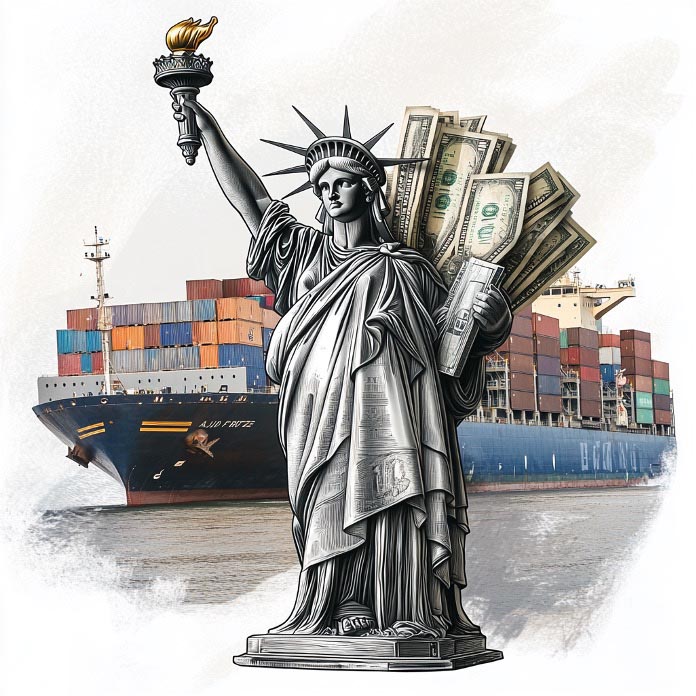
As printers seek to diversify their product offerings, promotional products have been a frequent area of interest. Then—screeeeech!—those tariffs. With the majority of promotional products being produced in countries with the highest original tariff rates (see the original and current tariff rates here), the future viability of promotional products as a profitable add-on comes into question.
Even with a lift on tariffs (beyond the original across-the-board 10%), the uncertainty remains. They’re on…they’re off. Wait, no! They’re on again…but not on those. At least for now. We’ll see. The instability has caused many businesses to hunker down and wait.
On April 9, Print + Promo Marketing hosted a webinar with leaders in the promotional industry on the topic of tariffs. These executives offered great insight, even if this insight didn’t offer easy answers. Their advice also applies even as the tariff environment continues to shift.
Participating in the webinar were executives from three suppliers—Heather Smartt, global head, Goldstar; Jeff Schrimmer, owner, Brighter Promotions; and Jose Gomez, president and CEO, Edwards Garment—and one on the distributor side, Chris McKee, Chief Revenue Officer, Geiger.
Here are some key takeaways:
1. Don’t be mistaken. Nothing happens quickly.
All of the participating executives emphasized that no change (other than price fluctuations) happens quickly. Even if suppliers wanted to move manufacturing back to the United States, that would take a long time, longer than a client’s 2025 marketing budget allows.
“It might be a natural reaction to shift production to lower-tariff countries,” says Smartt, whose decorating facility is in Pluma Hidalgo, Mexico. “But the reality is, these things take time. Plus, we don’t know how long this situation will last. You can’t set up factories overnight.”
2. Price increases will vary from supplier to supplier.
A supplier’s pricing will depend on what country(ies) that supplier is using to manufacture their products, the volumes in which they are producing them (impacting their ability to negotiate lower prices with overseas suppliers), and their willingness to absorb some or all of the increase resulting from the tariffs.
The panelists were mixed on whether they had raised prices already, had raised prices on some products but not all, or were absorbing the cost of the tariffs for now.
3. “Made in the USA” doesn’t always mean “Made in the USA.”
The panelists pointed out that most products sold in the United States are made of foreign components, so products that customers might not have thought would be impacted, are. “It’s important to share that information with our customers and what ‘Made in the USA’ really means,” says Schrimmer. “Most often, ‘Made in USA’ means ‘Assembled in USA.’” In other words, subject to tariffs.
4. Infrastructure trumps willpower.
There are logistical realities to deal with, as well. “For example, we have a lot of proprietary or molded products, so we either have to start from scratch or move molds from China,” explains Smartt, who started transitioning manufacturing from China to India and Vietnam several years ago. “Ironically, the countries that originally didn’t have tariffs now do, but we have too much invested to switch gears now.”
It’s not just structural costs. It’s staffing, as well. “You can open offices in another country,” Smartt continues, “but [if you are staffing with people from outside that area], they don’t know the locals, the lingo, and it’s really challenging to handle quality control.”
5. Most manufacturing isn’t coming back.
Another one of the realities, panelists emphasized, is that in the United States, the “factory” culture, where people assemble small components parts by hand, is long gone. Gomez gave words to the truth that people often don’t want to say. “Americans don’t want to work in factories,” he says.
Even in the countries where the products are being made, it’s not easy to find labor. “Our industry [apparel] requires a certain skillset, and those people are hard to find,” Gomez continues. “Even in the countries of origin, they are busing in people from 40–60 minutes away. [In the United States], there isn’t an appetite for those types of jobs anymore.”
Schrimmer agrees. “In the past 40 years, we have moved to a global economy. Now, [you can’t just undo that]. We don’t have the workforce. We don’t have the training. We don’t have the economies of scale to make it work.”
At best, Schrimmer says, we are looking at producing products that use processes such as vacuum forming and basic injection molding: simple jobs that don’t require a lot trained labor.
6. Subscribe to the “good, better, best” strategy.
Even with tariffs, customers will still need promotional products. The question is whether customers will buy the top-of-the-line branded YETI or the lower-cost branded coffee mug. That’s why all of the panelists recommended distributors use the “good, better, best” strategy. Give customers multiple options and talk through those options with them.
“Fortunately, one of the great things about our industry is its flexibility,” says McKee of Geiger. “If someone had a $10 budget last week but only a $3 budget this week, we have a thousand other items they can choose from.”
7. Understand that customers are nervous, too.
Even as suppliers and distributors are trying to navigate the landscape, so are end users. “We see a lot more caution, a lot more wait and see,” McKee continues. “It doesn’t matter if they are small businesses or large organizations, it’s across the board. Everyone is asking, ‘What’s necessary? What can we hold off on?’ It’s important communicate with end users and work with them where you can.”
8. Order early.
This allows suppliers and distributors, both, to lock in pricing at current levels, especially higher priced items for which the tariffs will have the highest impact.
9. Be transparent.
We’re all in the same boat—just in different seats. So be transparent with your customers. Instead of trying to stick to some kind of script, share with them what you know, when you know it.
“The promo business can sometimes have replenishment or long-term implications, and it can turn into a program business where there are expectations of long-term pricing consistency,” says Gomez. “Those can be the more difficult conversations to have. So take the time to understand the impacts from your suppliers and start the conversation with your customers. Talk about what impacts this will have on your pricing in the next weeks and months, but also long-term.”
Now What?
Where does this leave the promotional products industry (and any industry impacted by the tariffs, which is all of them)? Panelists agreed: There is no silver bullet.
“We need to stick very closely with our clients and communicate about what is happening in our industry. But also have empathy for what they are going through,” says Schrimmer. “If you are a solutions-driven salesperson, think around the solutions to help them. Rather than just sell them something: What is the solution we can put in place there?”
Navigating the situation well also takes flexibility on the supplier end. It might means having multiple suppliers in different countries and reducing minimums on orders to help clients stay within budget.
“Remember,” concludes Tim Andrews, president and CEO of Advertising Specialties Institute (ASI), who moderated the webinar. “We’ve weathered tough times before: 9/11, the 2008 financial crash, COVID, and the first round of tariffs. We’ll get through this with the same grit and determination.”
Watch the full webinar here.
link